What PFAS Limits Does Regulation (EU) 2025/40 Set for Food Packaging and How Is Compliance Tested?
What Are PFAS and Why Does Regulation (EU) 2025/40 Regulate Them in Food Packaging?
Regulation (EU) 2025/40 on packaging and packaging waste (PPWR) responds to a broader European goal: harmonizing packaging rules across all Member States, preventing and reducing the impact of packaging and packaging waste on the environment and human health, and moving toward a circular economy that reduces the consumption of virgin raw materials and the emissions associated with their production. Within this general framework, one of the aspects that raises the most questions for manufacturers and packers is the one governing the presence of PFAS in food contact materials.
PFAS (per- and polyfluoroalkyl substances) are a broad group of chemical compounds commonly used in food packaging for their resistance to grease, water and heat. They are frequently found in coatings, varnishes, inks, adhesives and functional layers of food contact packaging, present in materials as diverse as plastic, glass, cardboard, caps, trays, cartons or fruit molds, among others.
The Regulation (EU) 2025/40 of the European Parliament and of the Council, known as the PPWR (Packaging and Packaging Waste Regulation), establishes the new European framework on packaging and packaging waste. It entered into force on 11 February 2025 and has been mandatory in all Member States since 12 August 2026, without the need for national transposition — unlike the Directive 94/62/EC it repeals. Unlike previous directives, this regulation applies directly in all Member States, removing the possibility of differing national interpretations. The same obligations apply in every EU country from the first day of application.
What PFAS Limits Does the Regulation Set for Food Contact Packaging?
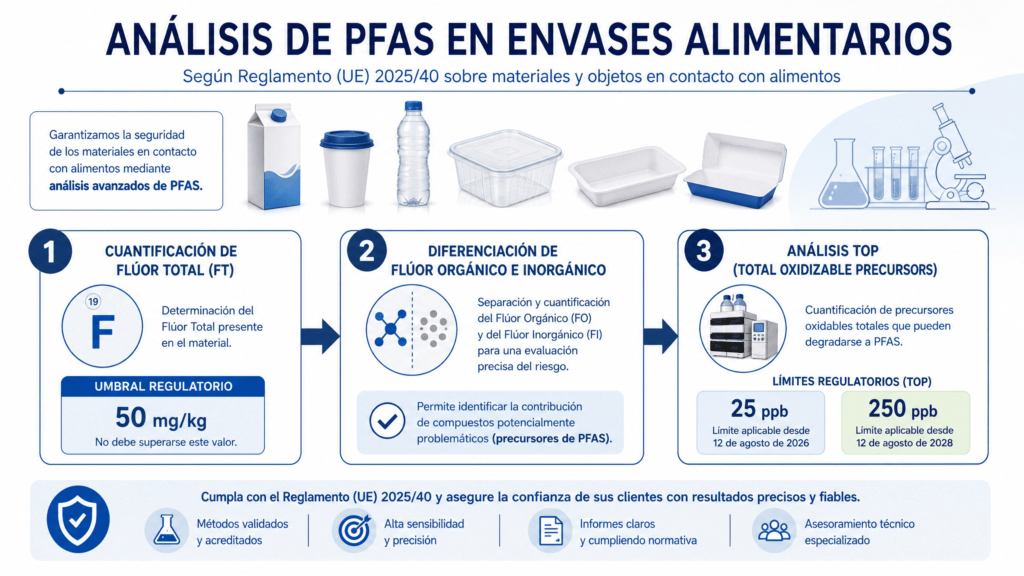
Article 5(5) of Regulation (EU) 2025/40 establishes that, as of 12 August 2026, food contact packaging may not be placed on the market if it contains PFAS at concentrations equal to or above the following values:
- 25 ppb for any individual PFAS measured by targeted analysis (excluding polymeric PFAS)
- 250 ppb for the sum of PFAS measured by targeted analysis, with prior degradation of precursors where applicable (excluding polymeric PFAS)
- 50 ppm for total PFAS, including polymeric PFAS
It should be noted that this is not a total ban on PFAS, but rather maximum concentration limits. These limits apply both to intentionally added PFAS and to those unintentionally present in the packaging. Packaging placed on the market before 12 August 2026 may remain in circulation. New batches introduced after that date must comply with these limits, with no stock depletion period.
What Role Does Total Fluorine Play as a Preliminary Indicator Before PFAS Analysis?
The Regulation refers to total fluorine as a practical starting indicator. If the total fluorine present in the packaging exceeds 50 mg/kg, the manufacturer, importer or intermediate user must be able to demonstrate which portion of that fluorine corresponds to PFAS and which to other fluorinated substances not classified as such. It is important to note that total fluorine is a broad indicator: it may originate from PFAS, but also from other unrelated fluorinated sources. Exceeding the 50 mg/kg threshold does not necessarily mean non-compliance — it requires an additional analytical step to determine the origin of that fluorine.
How Is Compliance Tested When There Is Not Yet a Harmonized European Method?
There is currently no harmonized European test method for PFAS in food packaging. To facilitate uniform application of the Regulation, the European Commission has published interpretive guidance proposing a three-stage analytical approach.
Stage 1: Total Fluorine (TF) Quantification
The first step consists of quantifying the total fluorine present in the packaging. If the result is below 50 mg/kg, the packaging can be considered compliant and there is no need to continue with the analytical process. This is the fastest and most cost-effective screening step, and it efficiently rules out risk in most materials that do not contain PFAS in significant amounts.
Stage 2: Differentiation Between Organic and Inorganic Fluorine
If total fluorine exceeds 50 mg/kg, the guidance recommends applying techniques such as pyrolysis GC/MS to determine whether the fluorine present is organic in nature — potentially associated with PFAS — or inorganic. If organic fluorine is below 50 mg/kg, the packaging can be considered compliant without the need to move on to the next stage.
Stage 3: TOP Analysis (Total Oxidizable Precursors)
The third stage is used to verify compliance with the specific limits of 25 μg/kg and 250 μg/kg. TOP analysis includes precursors: compounds that do not appear as target PFAS in a conventional targeted analysis, but which, after controlled oxidation, can convert into measurable PFAS. This is the most comprehensive and technically demanding step in the process, and the one that provides the most complete picture of the actual PFAS load in the material analyzed.
Who Is Affected by This Restriction and What Packaging Is Included?
The restriction affects the entire food contact packaging chain: primary packaging manufacturers, intermediate manufacturers and converters, importers, food packing companies and food producers that use their own packaging. This includes any packaging element that may come into direct contact with food: trays, films, coatings, varnishes, inks, adhesives and functional layers with barrier, grease-resistant or moisture-resistant properties. The Regulation covers the packaging as a whole, not just the main material. A cardboard tray with a functional coating, for example, must be analyzed taking into account all of its components in contact with food, not just the paper or cardboard substrate.
Frequently Asked Questions About PFAS in Packaging and Regulation (EU) 2025/40
Does the PPWR Completely Ban PFAS in Food Packaging?
No. The Regulation sets maximum concentration limits, not a total ban. PFAS present below the established thresholds are compliant. This applies both to intentionally added PFAS and to those present unintentionally.
What Happens If Total Fluorine Exceeds 50 mg/kg but Does Not Come from PFAS?
The manufacturer or importer must be able to provide technical documentation justifying that the fluorine present is not organic in nature and associable with PFAS, by differentiating through analysis between organic and inorganic fluorine. If the organic fluorine remains below 50 mg/kg, the packaging can be considered compliant.
Is There Already an Official European Method for Analyzing PFAS in Packaging?
There is not yet a single harmonized method. The European Commission has published guidance proposing the staged approach (total fluorine → organic/inorganic differentiation → TOP analysis) while work continues toward methodological harmonization among European laboratories and authorities.
Do the PPWR Limits Replace Those of Other Regulations Such as REACH or Food Contact Materials Rules?
Not directly. The limits set by Regulation (EU) 2025/40 do not automatically carry over to other regulations. The European Commission is assessing possible overlaps between the PPWR, REACH and food contact materials legislation, but as of today these remain independent regulatory frameworks.
What Documentation Should a Packaging Manufacturer or Importer Have Ready?
Every item of packaging placed on the market from 12 August 2026 must be accompanied by an EU Declaration of Conformity (DoC) certifying compliance with the Regulation’s requirements, including those related to PFAS. This documentation must be available upon request from market surveillance authorities.
Are Packaging Items Made with Recycled Material Exempt from These Limits?
No. The Regulation does not provide for exceptions for packaging containing recycled material. PFAS limits apply to the final packaging regardless of its origin or composition.
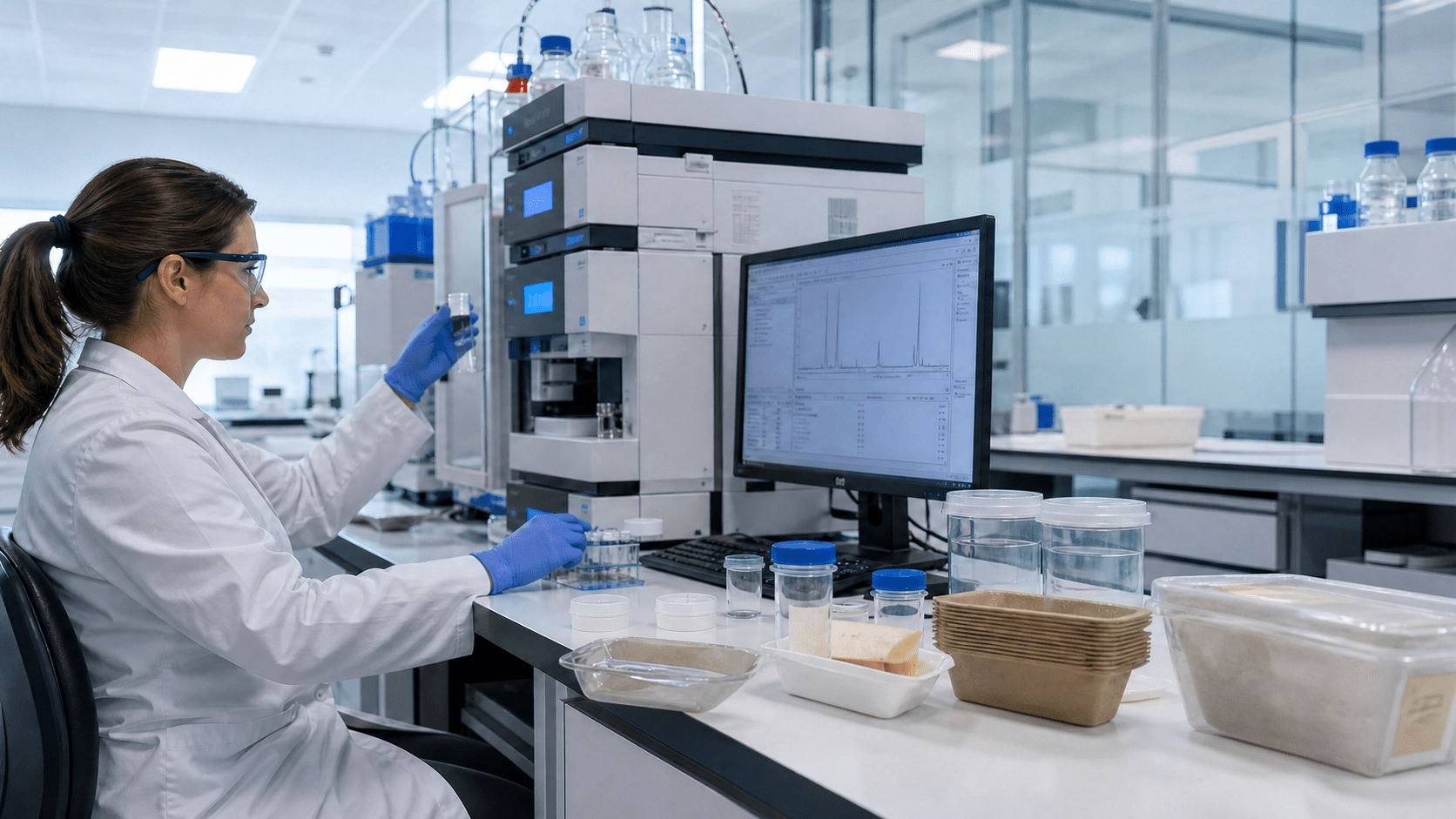
At Laboratorio Agrama we carry out total fluorine analysis and, when the result requires it, the complementary analytical stages to determine the presence of PFAS in food contact packaging, supporting manufacturers and packing companies in interpreting their results against Regulation (EU) 2025/40. Email: agrama@laboratorioagrama.com Phone: 95 490 60 43 Website: www.laboratorioagrama.com