PFAS in Feed: What EU Recommendation 2026/1307 Establishes
The European Commission has approved a new Recommendation calling for the monitoring of PFAS in animal feed over the next three years. Below we explain exactly what this rule establishes, which substances and which types of feed it affects, and what it means in practice for feed manufacturers and livestock farms.
What has the European Commission published on PFAS in feed?
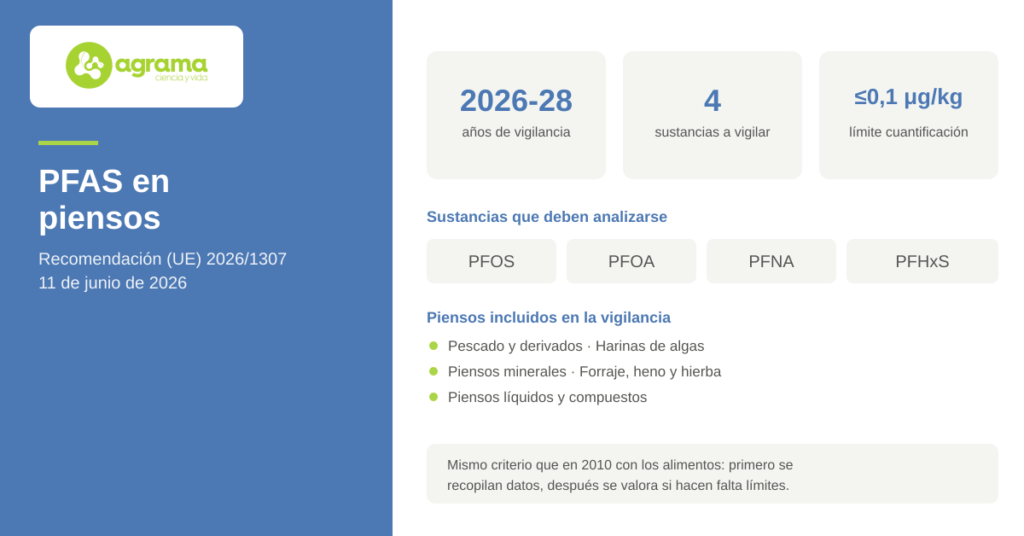
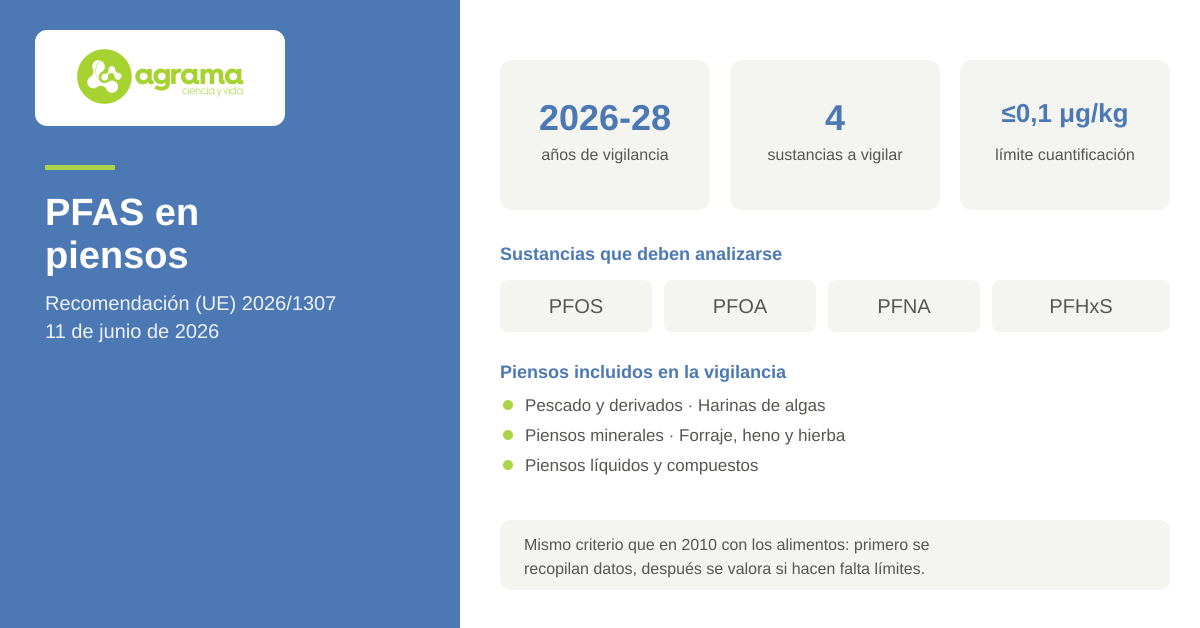
On 11 June 2026, the European Commission adopted Recommendation (EU) 2026/1307 on the monitoring of per- and polyfluoroalkyl substances (PFAS) in animal feed. The text asks Member States, together with industry operators, to monitor the presence of PFAS in feed during 2026, 2027 and 2028.
It is not a regulation. It is a recommendation, and that matters: it does not currently impose binding maximum levels or direct penalties for exceeding them. What it does is request data — the same kind of data that, in the case of food, later made it possible to set the limits that exist today.
Why feed now, and not only food?
Until this Recommendation, EU rules on PFAS had focused on other points in the chain:
- Drinking water — RD 3/2023: sum of 20 individual PFAS ≤ 0.10 μg/L; total sum ≤ 0.50 μg/L.
- Food of animal origin — Regulation (EU) 2022/2388: maximum levels for PFOS, PFOA, PFNA and PFHxS.
- Food packaging — Regulation (EU) 2025/40 (PPWR): 25 μg/kg per individual PFAS, 250 μg/kg sum, 50 mg/kg total fluorine, in force since 12 August 2026.
What was missing was the starting point of that chain: feed itself. EFSA had already confirmed that PFAS transfer from feed to food of animal origin, with clear differences depending on the species and the type of PFAS. Until now, however, there was not enough data on how much of these substances feed marketed in the EU actually contains. This Recommendation aims to close that information gap before deciding whether maximum levels are also needed at this stage.
Which substances must be monitored?
Four compounds, the same ones already regulated in food:
- PFOS (perfluorooctane sulfonic acid)
- PFOA (perfluorooctanoic acid)
- PFNA (perfluorononanoic acid)
- PFHxS (perfluorohexane sulfonic acid)
Which types of feed are affected?
- Fish, other aquatic animals and their derivatives
- Meals and other raw materials derived from seaweed and algae
- Feed materials of mineral origin
- Forage, silage, hay and fresh grass
- Liquid feed
- Compound feed containing fish or algae among its ingredients
On farms where elevated PFAS levels are detected in food of animal origin, the Recommendation calls for extending testing to the soil where animals forage and to drinking water, as part of the follow-up investigation.
What does PFAS monitoring in feed require at analytical level?
The analytical methods used must achieve quantification limits equal to or below 0.1 μg/kg for each of the four substances. Sampling must follow the procedure set out in Regulation (EC) 152/2009, the EU’s reference standard for feed sampling. This requirement places PFAS analysis in feed at the same level of precision already applied to water and food: it relies on liquid chromatography coupled with tandem mass spectrometry (LC-MS/MS), the only technology capable of reliably quantifying such low concentrations.
What regulatory pattern lies behind this Recommendation?
The experience with food of animal origin is revealing: the first recommendation on PFAS monitoring in food dates back to 2010 (Recommendation 2010/161/EU). Data collected over more than a decade provided the basis for the binding maximum levels set in 2022, which remain in force today. The same pattern is now being applied to feed: monitoring first, then — if the data justifies it — regulation with limits.
What should your company do now?
If you manufacture feed, import raw materials or manage a livestock farm, here are reasonable steps to take while the regulation evolves:
- Identify which raw materials in your supply chain fall within the scope of the Recommendation (fish, algae, forage, liquid feed).
- Prioritise testing for raw materials with a higher likelihood of historical PFAS exposure (industrial areas, proximity to contaminated water).
- Start generating your own data now, at a steady pace, rather than waiting for a legal obligation to exist.
- Consult a specialised laboratory if you have doubts about which matrices in your production process could be affected.
Frequently asked questions
Is it mandatory to test for PFAS in feed from 2026?
No. Recommendation (EU) 2026/1307 is not binding: it asks Member States to carry out monitoring, but it does not currently impose maximum levels or penalties on companies.
What is the difference between this rule and the one regulating PFAS in food?
Regulation (EU) 2022/2388 sets binding maximum levels for food of animal origin. Recommendation (EU) 2026/1307 only asks for data to be collected on PFAS in feed, the preliminary step before deciding whether limits are needed at this stage of the chain.
Which PFAS must be tested for in feed?
PFOS, PFOA, PFNA and PFHxS, with a required quantification limit of 0.1 μg/kg per substance.
How long will the monitoring last?
Three years: 2026, 2027 and 2028.
At Laboratorio Agrama we can help you test for PFAS in your feed and raw materials. Contact us at agrama@laboratorioagrama.com or on +34 95 490 60 43.